De lo liquido ahí donde otros han fracas ado yo no fracasé, 10000, Museo Universitario del Chopo, Mexico City, Mexico
Museo Universitario del Chopo
August 11th - October 28th 2018

Exhibition View

Exhibition View

Exhibition View
Exhibition View

Exhibition View
Exhibition View

Aquarization Exercise No. 5 (Ceramic Tracing of Geometry by Carlos Mérida), High-temperature ceramic, 25 x 20 x 8 cm, 2018

Aquarization Exercise No. 3 (Ceramic Tracing of B11 Bólido Box 9 by Hélio Oiticica), High-temperature ceramic, 10 x 20 x 10 cm, 2018

Aquarization Exercise No. 3 (Ceramic Tracing of B11 Bólido Box 9 by Hélio Oiticica), High-temperature ceramic, 10 x 20 x 10 cm, 2018

Aquarization Exercise No. 4 (Ceramic Tracing of Fountain Paqcha IV by César Paternosto), High-temperature ceramic, 23 x 15 x 7 cm, 2018

Aquarization Exercise No. 2 (Ceramic Tracing of Inclined Cube by Eduardo Ramírez Villamizar), High-temperature ceramic, 25 x 25 x 25 cm, 2018

Exhibition View
Of that Which is Liquid in Water; There Where Others Have Failed I Did Not
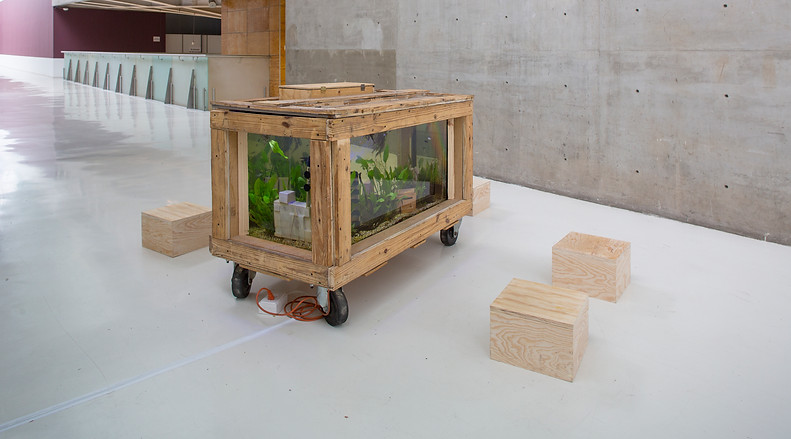
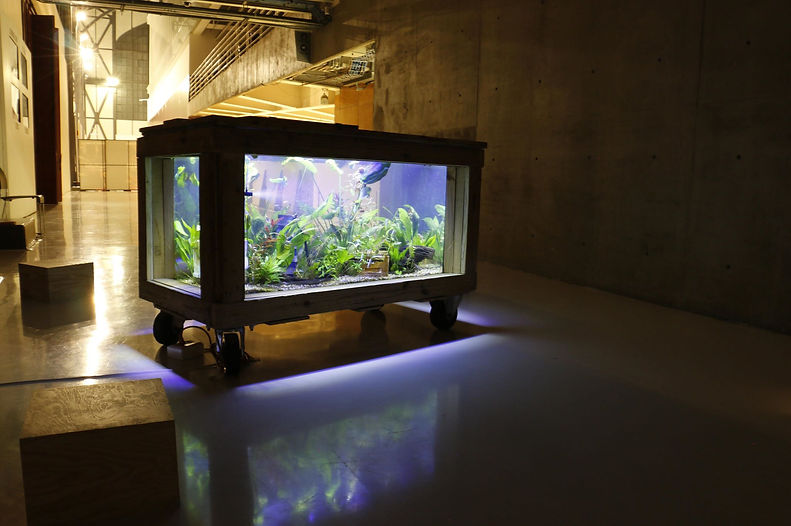
Project 10,000 visits the museum with the exhibition by Mexican artist Marek Wolfryd. 10,000 is an exhibition space that Armando Rosales created in 2016 with the artwork crate that belonged to Venezuelan artist Carlos Cruz-Diez. This artwork crate fulfills the functions of a nomadic gallery that moves from one place to another in Mexico City and allows for a reconsideration of the use of economic resources, exhibition policies, and site-specific projects. In his exhibition "On the Liquidity of Water; There Where Others Have Failed I Did Not Fail," Marek Wolfryd presents an intervention to this device through his own revision of liquid geometrism.
Geometrism is a concept born in Latin America. As a critical tendency, it was capable of uniting, within the same category, a series of continental artists from the sixties and seventies, whose work moved through both mathematics and magical-religious references. It also functioned as a strategy for an explicit dialogue between technology and nature; it was a step from non-objective art to urban art, situated in modernization processes of the large metropolises.
Wolfryd's intervention questions the constitution of the museum in the Latin American context, through a reflection on its forms of public and systematized exhibition, just as occurred with the first scientific cabinets. The piece combines elements of local "nature" and places them in an aquarium. This clash allows for bringing geometrism—endemic to this southern region—back to life through an artificial pond that is expanded toward a series of sculptural volumes, emphasizing a cyclical circulation that concludes in a ceramic revival, based on the works of Carlos Mérida (Mexico), Hélio Oiticica (Brazil), César Paternosto (Argentina), Eduardo Ramírez Villamizar (Colombia), and Cruz-Diez himself.
As a prototype of an aquatic, freshwater, and tropical habitat, the aquarium will cohabit for the first time with a museum and will trigger questions about the flow of values in which conditions specially created to house artistic practices, their potentials and their contradictions, unfold.
Natalia de la Rosa